Concrete removal in Sacramento addresses driveways, sidewalks, patios, parking lots, slabs, foundations, curbs, gutters, retaining walls, and other concrete structures that have reached the end of their service life or must be removed to accommodate new construction. Sacramento’s climate creates specific concrete deterioration mechanisms alkali-silica reaction from the region’s aggregates, shrinkage cracking in hot dry conditions, and expansion damage from the valley’s freeze-thaw temperature cycles that drive a substantial volume of Concrete Removal Sacramento work throughout the region.
Understanding how concrete is removed professionally what equipment is used, how reinforcement is managed, how disposal is handled, and what regulatory requirements apply provides the context for understanding concrete removal as a specialist activity that goes beyond simply breaking and hauling.
Why Concrete Deteriorates in Sacramento’s Climate
Sacramento’s hot, dry summers are particularly hard on concrete. High temperatures and low humidity drive rapid moisture evaporation from freshly placed concrete, causing plastic shrinkage cracking during curing. In exposed slabs sidewalks, driveways, and patios the diurnal temperature swing between hot summer afternoons and cool nights drives thermal expansion and contraction cycles that widen existing cracks and initiate new ones.
Alkali-silica reaction (ASR) is a concrete deterioration mechanism that is prevalent in Sacramento because the aggregate used in Central Valley concrete often contains silica minerals reactive with the cement’s alkali content. ASR produces a gel that absorbs water and expands, creating a distinctive pattern of surface map cracking (crazing) and in severe cases causing concrete to pop and spall. ASR is a long-term process that manifests over decades in older concrete structures, and much of the concrete removal work in Sacramento’s established neighborhoods addresses ASR-affected slabs from mid-century construction.
Ground movement from Sacramento’s Vertisol clay soils is another primary cause of concrete failure. Shrink-swell cycling in these soils lifts and drops concrete slabs seasonally, creating differential settlement at joints and edges. The curling and warping of slabs that results concentrates stresses at unsupported slab corners and joints, leading to corner cracking, joint spalling, and in severe cases complete slab separation from the subgrade.
Concrete Removal Methods and Equipment
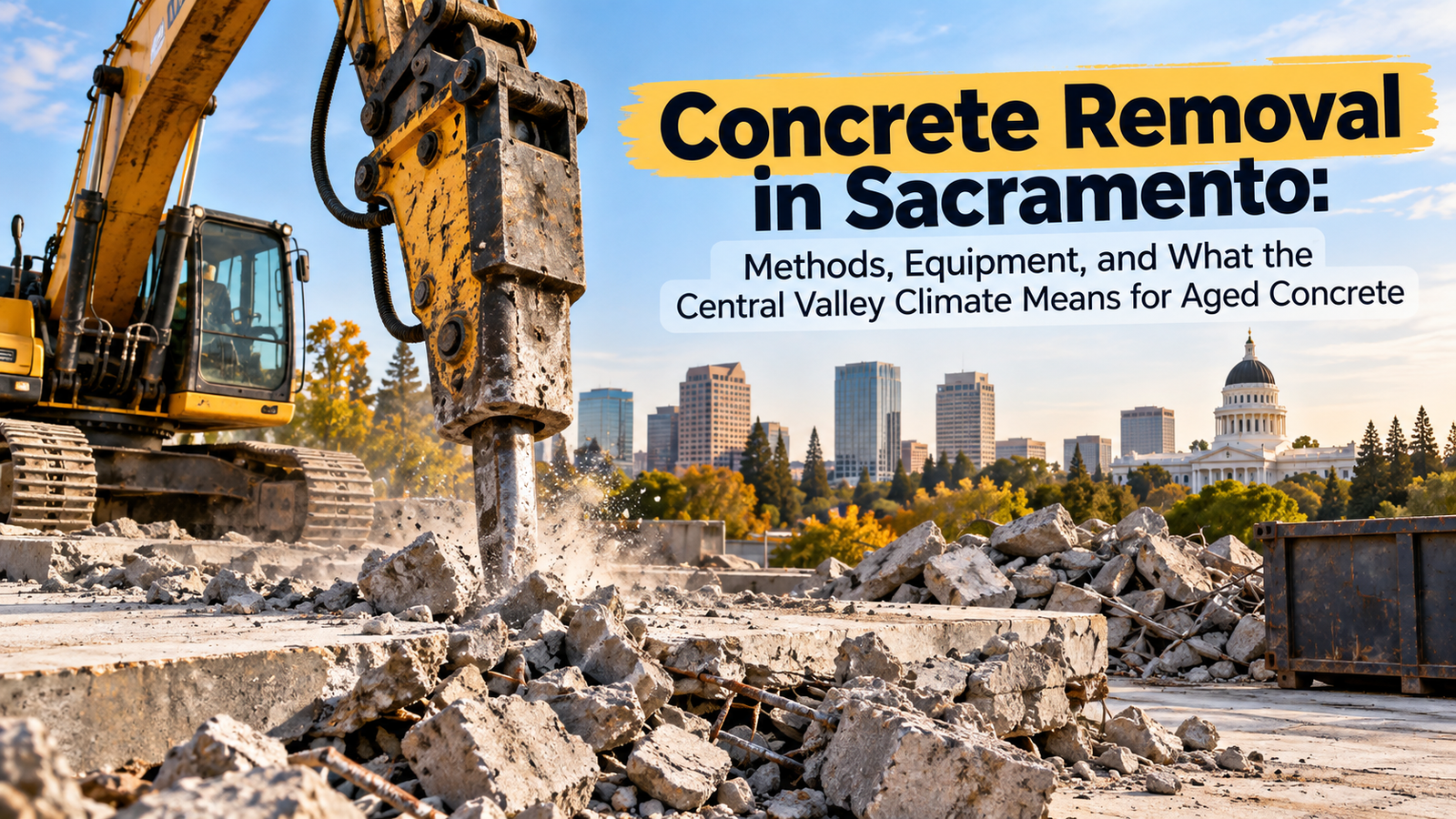
The dominant method for concrete removal in Sacramento is hydraulic breaking using a hydraulic breaker (jackhammer attachment) on a compact to mid-size excavator or skid-steer loader. The hydraulic breaker fractures concrete slabs into manageable pieces that can be picked up and loaded into trucks using a hydraulic grapple. This method is efficient on open sites and is well-suited to driveways, parking lots, and large slabs.
For reinforced concrete slabs, walls, and foundations containing steel rebar concrete breaking produces sections bound together by the reinforcement. A hydraulic shear attachment cuts rebar efficiently, allowing reinforced sections to be broken free and loaded without the time-consuming manual cutting that older methods required. Concrete saws gas-powered or electric diamond blade saws are used to cut straight lines at the boundaries of partial removal projects, preventing damage to adjacent concrete that is to be retained.
In confined spaces interior demolition, narrow alleys, or work adjacent to structures electric-powered chipping hammers and demolition hammers are used where exhaust-producing equipment is inappropriate. Robotic demolition machines remote-controlled compact demolition units can work in areas too confined or hazardous for operator-occupied equipment.
Concrete Recycling in Sacramento
Concrete is one of the most recyclable materials in construction. Crushed concrete aggregate is a widely accepted substitute for virgin aggregate in base course applications, pavement subbase, utility bedding, and fill applications. Sacramento has a well-developed infrastructure of concrete recycling facilities including operations at major aggregate producers and at C&D recycling processors throughout the county that accept clean concrete demolition material and process it into recycled base products.
Recycling concrete from Sacramento removal projects diverts material from landfills, reduces the demand for virgin aggregate from valley quarries, and in many cases produces a product that is used on the same project where the original concrete was removed. Crushed concrete base is specified for paving base course on many Sacramento projects, and contractors who produce their own recycled aggregate from concrete removal work have a cost-effective material source for paving base.
Contaminated concrete material with petroleum staining, lead paint coating, or other hazardous material contamination cannot go to standard recycling facilities. Characterization sampling determines whether concrete is clean for recycling or requires disposal at a facility permitted for the contamination level.
Partial Removal and Selective Concrete Demolition
Not all concrete removal projects involve complete removal of a slab or structure. Partial removal often called selective concrete demolition removes specific sections while retaining adjacent areas. Common scenarios include removing and replacing a single driveway panel that has settled or cracked, replacing a run of sidewalk panels while retaining adjacent sections, and opening excavation windows in parking lot slabs for utility repair or new utility installation.
Selective concrete demolition requires saw cutting the boundary of the removal area before breaking begins. The saw cut provides a clean, straight joint at the edge of the work and prevents the shock of hydraulic breaking from damaging the adjacent retained concrete. Joint sealant is applied to the new joint after replacement concrete is placed, maintaining the watertight integrity of the repaired area.
Matching the existing concrete surface texture and finish in partial replacement projects is an aesthetic challenge in Sacramento’s high-contrast sunlight. Smooth-troweled, exposed aggregate, and broom-finished surfaces all age and color differently, and new concrete panels adjacent to weathered concrete can be visually distinct for several years until the replacement weathers to a comparable tone.
Disposal and Regulatory Requirements for Concrete Removal in Sacramento
Concrete demolition debris in Sacramento is classified as inert solid waste and is regulated under the California Integrated Waste Management Act. Clean concrete can be recycled at permitted facilities or taken to construction and demolition debris transfer stations. The City of Sacramento’s C&D Debris Recycling requirement mandates that permitted construction and demolition projects divert 65 percent of their C&D debris from landfill disposal, with documentation provided as a condition of permit closeout.
Rebar and steel from reinforced concrete removal is a recyclable commodity. Steel scrap markets in Sacramento accept clean rebar and structural steel at current scrap prices. Separating rebar from concrete debris on site improves recycling rates and reduces net disposal cost.
Frequently Asked Questions: Concrete Removal in Sacramento
What causes concrete driveways and patios to fail in Sacramento?
Alkali-silica reaction from reactive aggregates, shrink-swell movement of Vertisol clay subgrades, thermal cycling from Sacramento’s hot summers, and in some cases ASR-induced map cracking in older concrete all contribute to concrete deterioration in the Sacramento area.
How is reinforced concrete removed?
Hydraulic breaker fractures the concrete; hydraulic shear cuts the rebar; grapple loads the pieces. Concrete saws cut boundaries for partial removal projects to prevent damage to adjacent retained concrete.
Can concrete from Sacramento removal projects be recycled?
Yes. Clean concrete is accepted at Sacramento-area recycling facilities and crushed into base aggregate for paving and utility bedding applications. Contaminated concrete requires characterization and disposal at appropriate facilities.
What is selective concrete demolition?
Removal of specific sections while retaining adjacent concrete. Saw cutting at the removal boundary prevents damage to adjacent areas. Common for driveway panel replacement, sidewalk repair, and utility access openings in parking lots.
Does Sacramento require documentation of concrete recycling for demolition projects?
Yes. Sacramento’s C&D Debris Recycling requirement mandates 65 percent diversion from landfill for permitted projects, with documentation at permit closeout. Recycling concrete, wood, and metal from demolition projects typically meets this requirement.
Concrete removal in Sacramento requires equipment capability, knowledge of the valley’s specific concrete deterioration mechanisms, and access to the region’s concrete recycling infrastructure. Professional concrete removal contractors in the Sacramento area combine these elements to execute removal projects efficiently, dispose of material responsibly, and prepare sites for the construction work that follows.